If you've ever grabbed a dry towel mid-workout to wipe away sweat, you might be undoing your own cooling system. Here's what's actually happening on your skin, and why switching to a cool, damp towel can help you go longer without cramping or crashing.
Core Message
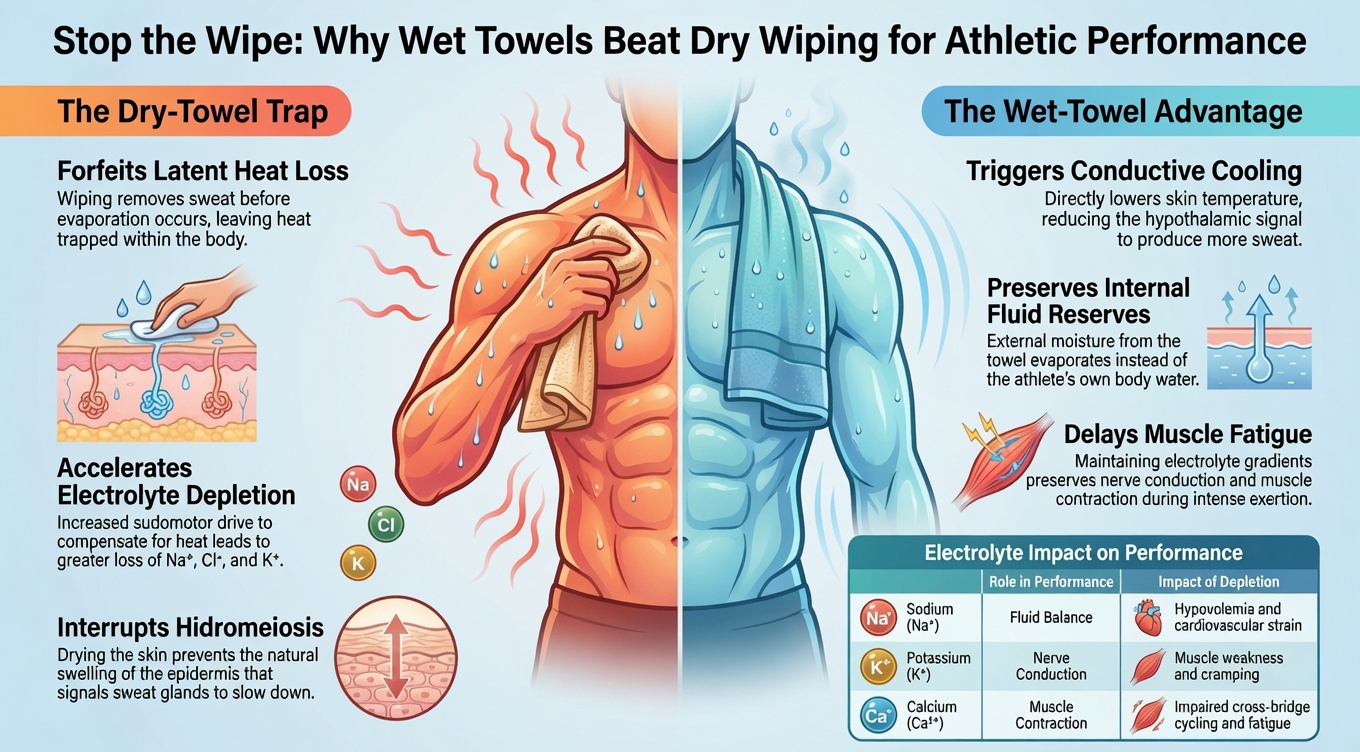
Using a dry towel to wipe sweat during exercise is counterproductive. It removes sweat before evaporation can cool the body, accelerates electrolyte loss, and disrupts the body's natural sweat regulation mechanisms. A wet towel is superior because it provides external cooling, conserves the athlete's internal fluid and electrolytes, and helps delay fatigue.
The Dry Towel Trap
- Forfeits latent heat loss: Wiping away sweat prevents evaporative cooling. Heat remains trapped in the body, forcing the thermoregulatory system to work harder.
- Accelerates electrolyte depletion: The body increases sweating (sudomotor drive, the nervous system's signal telling sweat glands to activate) to compensate for the lost cooling effect. This leads to greater losses of sodium (Na⁺), chloride (Cl⁻), and potassium (K⁺).
- Interrupts hidromeiosis: Normal skin swelling from moisture signals sweat glands to reduce output. Hidromeiosis is the skin's natural way of telling sweat glands to slow down once it senses enough moisture. Dry wiping removes this feedback, so sweating continues at a higher rate than necessary.
The Wet Towel Advantage
- Triggers conductive cooling: A cool, wet towel directly lowers skin temperature. This reduces the hypothalamic drive to produce additional sweat.
- Preserves internal fluid reserves: Moisture from the towel evaporates instead of the athlete's own body water, conserving plasma volume.
- Delays muscle fatigue: By limiting unnecessary electrolyte loss, nerve conduction and muscle contraction remain more efficient for longer.
Electrolyte Impact on Performance
| Electrolyte | Primary Role | Consequence of Depletion |
|---|---|---|
| Sodium (Na⁺) | Fluid balance | Hypovolemia and cardiovascular strain |
| Potassium (K⁺) | Nerve conduction | Muscle weakness and cramping |
| Calcium (Ca²⁺) | Muscle contraction | Impaired cross-bridge cycling and fatigue |
Practical Takeaway
During training or competition, athletes should prefer a cool, damp towel over repeated dry wiping. This simple change supports more effective thermoregulation, reduces unnecessary fluid and electrolyte losses, and helps maintain performance for a longer period.
Ready to put this into practice? Book a lesson or check out our Practice Hub for more ways to train smarter, not just harder.